
As companies are grappling to comply with DPDPA in less than 15 months from now, a key requirement for Significant Data Fiduciaries (SDF) is to conduct an annual Data Audit under Section 10. This requirement directly correlates to the fundamental privacy principle of accountability. Organizations based in India, especially those that pose a high risk to the rights of Data Principals and/or have a potential impact on the sovereignty and integrity of India, need to implement additional measures to protect personal data; and one of the important ways to do so is by conducting annual Data Audits.
So, what is a Data Audit? Under the DPDPA, a Data Audit is an independent evaluation of a Data Fiduciary’s compliance with the provisions of the Act. The audit evaluates various parameters, such as whether personal data is processed lawfully as per the DPDPA, whether adequate security safeguards are implemented to protect personal data, whether grievance redressal mechanisms implemented by SDFs are effective and assist Data Principals, and whether consents are managed appropriately as per the Data Principal’s instructions, etc.
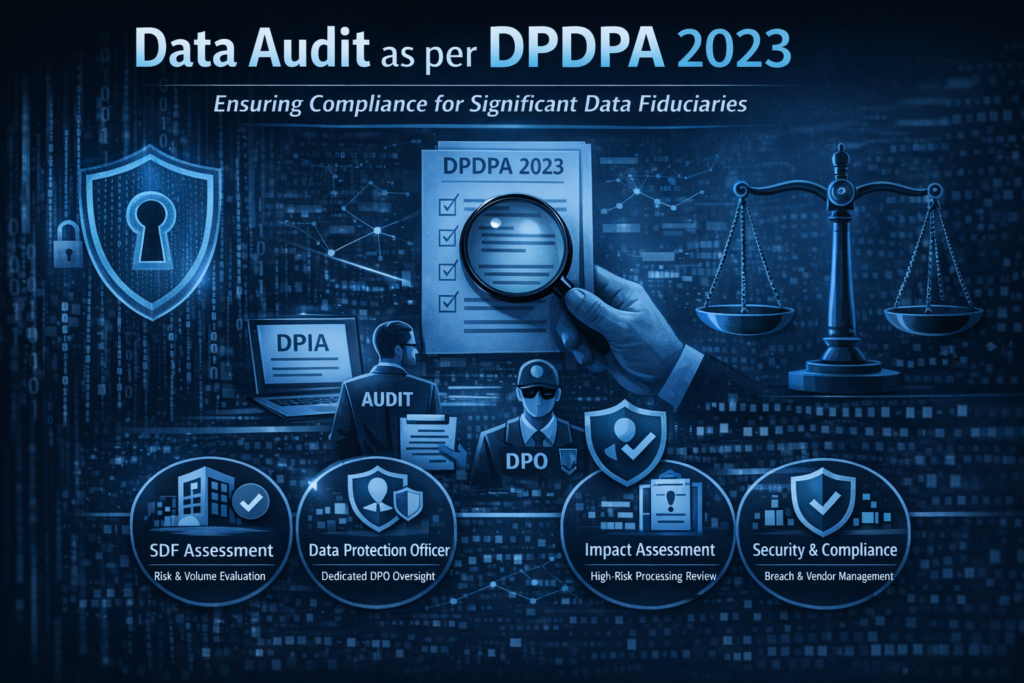
Under the DPDPA, Data Audits are mandatory for organizations classified as Significant Data Fiduciaries (SDFs). However, a degree of uncertainty still persists around which entities will ultimately fall within this category. While the Act lays down high-level criteria—such as volume and sensitivity of personal data processed, risk to data principals, and impact on sovereignty and public order—the absence of detailed, implementable thresholds leaves organizations in a grey zone. In this environment, a prudent approach would be for organizations processing large volumes of personal data to begin strengthening their privacy governance frameworks proactively. Preparing early not only reduces future compliance friction but also signals accountability and maturity in data governance. When formal SDF notifications and detailed criteria are eventually published, organizations that have already embedded structured processes will be significantly better positioned to demonstrate compliance.
The enforcement of these audits would be done the Data Protection Board of India, however the Board adjudicates non-compliances. Additionally, the audit standards are unknown and it has not published the list of accredited list of auditors.
The likely coverage of such audits may include legal compliance review, governance review, technical and organizational safeguards review, and data lifecycle mapping. However these are broad coverage areas and further information on the coverage is expected to be published by The Board.
As from the above points, you may observe that we are expecting a lot of clarifications to be provided; however, I’ve put together a detailed check-list below which may help SDFs in complying with the regulation.
| Domain | Domain Description | Key Questions to Ask |
|---|
| 1. SDF Assessment & Governance | Assessment of potential Significant Data Fiduciary classification and establishment of privacy governance structure with senior oversight. | – Has the organization documented its assessment against SDF criteria? – Is there defined senior management/board oversight for data protection? – Are privacy roles and responsibilities formally documented? |
| 2. Data Protection Officer (DPO) | Mandatory appointment and operational independence of the DPO. | – Has a DPO been formally appointed and notified internally? – Are the DPO’s responsibilities and reporting lines clearly defined? – Is the DPO accessible to data principals for grievances? |
| 3. Independent Data Auditor & Periodic Audit | Appointment of an independent auditor and conduct of periodic data audits. | – Has an independent Data Auditor been appointed (where applicable)? – Is the audit scope documented and risk-based? – Are audit findings tracked to closure? |
| 4. Data Protection Impact Assessment (DPIA) | Identification and mitigation of high-risk processing activities. | – Has the organization identified high-risk processing activities? – Are DPIAs conducted using a documented methodology? – Are mitigation measures implemented and reviewed periodically? |
| 5. Data Inventory & Purpose Governance | Maintenance of data inventory and enforcement of purpose limitation and data minimization. | – Is there a centralized inventory of personal data processed? – Are processing purposes documented and communicated? – Is data minimization demonstrable in practice? |
| 6. Lawful Processing & Data Principal Rights | Mechanisms to ensure lawful processing and enable exercise of data principal rights. | – Is valid consent or lawful basis documented? – Are systems in place to manage access, correction, erasure, and grievance requests? – Are requests logged and resolved within prescribed timelines? |
| 7. Security Safeguards & Access Controls | Implementation of technical and organizational safeguards to protect personal data. | – Are appropriate technical and organizational security controls implemented? – Is access restricted based on role and business need? – Are security assessments (e.g., VAPT, audits) conducted periodically? |
| 8. Personal Data Breach Management | Structured incident detection, response, and notification mechanism. | – Is there a documented breach response plan? – Are reporting and escalation timelines clearly defined? – Are incidents documented and lessons learned captured? |
| 9. Vendor & Third-Party Management | Oversight over processors and third parties handling personal data. | – Are Data Processing Agreements executed with vendors? – Are third parties assessed for privacy and security controls? – Are cross-border data transfers evaluated for compliance? |
| 10. Retention, Deletion & Documentation Controls | Controls for storage limitation, deletion, training, and maintenance of compliance artefacts. | – Is there a documented data retention and deletion policy? – Are compliance artefacts (policies, DPIAs, audit logs) centrally maintained? – Is periodic privacy training conducted and tracked? |
So, what should organizations do today? The data audit requirement under the DPDPA is not merely a compliance checkpoint — it is a structural shift toward demonstrable accountability.
The law establishes the obligation.
Regulatory guidance will define the mechanics.
But organizational intent will determine the outcome.
For entities that are likely to be classified as Significant Data Fiduciaries, the question is no longer whether to prepare, but how soon. Early investment in structured data mapping, governance clarity, documentation discipline, and independent oversight will not only ease future compliance burdens but also strengthen institutional credibility.
In a regime built on accountability, preparedness is not a competitive advantage.
It is a baseline expectation.